Throw, Glaze, Take Home: Why Sapporo's Pottery Studios Are the Souvenir Experience You Didn't Know You Needed
Let's be honest about the souvenir problem. You've been there — standing in some airport gift shop holding a refrigerator magnet shaped like a torii gate, wondering how it came to this. You spent two weeks in one of the most craft-rich countries on the planet and the best you could do was a $4 piece of injection-molded plastic.
Sapporo has a better answer, and it involves getting your hands dirty.
The ceramics scene here is genuinely something special. Unlike Tokyo, where studio workshops have increasingly become polished, Instagram-optimized experiences catering to an international crowd, Sapporo's pottery studios tend to be smaller, more personal, and run by artists who are actually invested in what you walk away with. The city sits in a region with deep craft traditions, and the potters working here have access to Hokkaido's distinct natural materials — local clays, glazes inspired by the island's volcanic landscapes and coastal palettes — that give finished pieces a character you won't find anywhere else in Japan.
And yes, you can ship it home. We'll get to that.
Why Sapporo's Studios Hit Different
The difference between a Sapporo pottery experience and what you'd find in, say, Asakusa comes down to scale and sincerity. Tokyo's tourist-facing workshops are often structured around throughput — get people in, let them press their hands into clay for forty minutes, hand them a finished cup three weeks later via mail. It's fine. It's just not memorable.
Sapporo studios, by contrast, frequently offer multi-hour sessions where you're working alongside the potter, not just following a laminated instruction sheet. Some offer full-day intensives. A handful will let you come back across multiple visits if you're staying long enough, which means you can actually learn something rather than just produce a lopsided bowl and call it culture.
The instructors here also tend to speak through their work in ways that feel genuinely rooted. Hokkaido has its own aesthetic sensibility — quieter, cooler, more influenced by the natural world than the neon density of the capital — and that shows up in the pottery. You're likely to encounter muted earth tones, organic asymmetry, and glazes that reference sea fog and pine forests rather than the bold graphic traditions of Kyoto or Aichi.
What to Actually Expect When You Book a Session
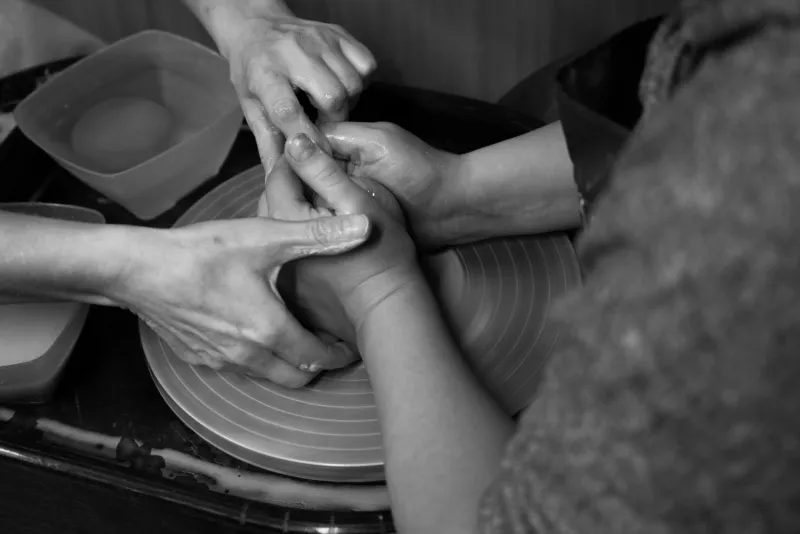
First-timers should know that most Sapporo pottery workshops are structured in one of two ways: wheel-throwing sessions or hand-building sessions. Wheel-throwing is what you picture when you think of pottery — clay spinning, hands shaping, the whole Ghost-movie moment. Hand-building is slower, more sculptural, and often more accessible for people who've never touched clay before.
Many studios offer both, and the staff are usually good at helping you figure out which suits your goals. If you want a functional piece — a mug, a small bowl, a sake cup — wheel-throwing is probably your move. If you're more interested in the meditative, tactile experience of working with clay without the pressure of a spinning wheel, hand-building workshops are excellent.
Plan for sessions that run between 90 minutes and three hours for beginner formats. Wear clothes you don't mind getting clay on — studios will often provide aprons, but clay has a way of finding the one patch of sleeve you left uncovered. Most sessions are conducted in Japanese, but many studios in Sapporo catering to visitors will have English-language handouts, and the physical nature of the craft means a lot of instruction translates just fine through demonstration.
Pricing typically runs between ¥3,000 and ¥8,000 per person depending on session length and what's included. That's roughly $20–$55 USD at current exchange rates — genuinely competitive with what you'd pay for a comparable craft experience stateside, and the result is something you made yourself in Hokkaido, which is worth considerably more than whatever that exchange rate suggests.
How to Find and Book the Right Studio
The honest answer is that Sapporo's best pottery studios aren't always easy to find through English-language Google searches. A few strategies that actually work:
Start with tourist information centers. Sapporo's main visitor information office near JR Sapporo Station keeps updated lists of craft workshops open to international visitors and can sometimes help with booking inquiries.
Look for studios in Odori and Maruyama neighborhoods. These areas have a higher concentration of independent craft studios and galleries. Walking the streets and looking for handwritten signs or small workshop spaces is genuinely a viable approach — some of the best studios have minimal online presence.
Check craft fair schedules. Sapporo hosts regular artisan markets, particularly in warmer months, where potters set up stalls. This is a great way to meet makers directly, see their work, and ask about workshop availability in person.
Use platforms like Airbnb Experiences or Voyagin. Both list curated pottery workshops in Sapporo with English-language booking and clear logistics. The experiences listed here tend to be well-vetted for international visitors, which takes some of the guesswork out of it.
When booking, always confirm the firing timeline. This is the piece that catches people off guard.
The Shipping Question (and the Firing Timeline)
Here's the thing nobody tells you before you sit down at the wheel: clay has to be fired in a kiln after you shape it, and that takes time. In most Sapporo studios, the kiln firing schedule means your finished piece won't be ready for pickup for one to three weeks after your session.
If you're only in Sapporo for a few days, you're almost certainly not leaving with your piece in your suitcase. Which means shipping.
The good news is that most studios are experienced with this. Japan Post's EMS (Express Mail Service) is the standard option for sending ceramics to the US, and studios will typically pack pieces carefully with sufficient cushioning. Shipping costs vary based on size and weight, but for a single mug or small bowl, expect to pay somewhere in the ¥3,000–¥6,000 range for EMS to the US — call it $20–$40. Delivery usually takes one to two weeks.
Some studios will handle the shipping logistics entirely on your behalf for a small handling fee, which is worth it for the peace of mind. Others will give you the packed piece and let you take it to the post office yourself. Either way, make sure you get a tracking number.
One practical note: ceramics shipped internationally need to be declared at customs, but a single handmade piece for personal use rarely triggers any issues. Just keep the receipt from the studio.
The Part That Makes It Worth It
Here's what nobody really talks about when they pitch craft workshops as a travel activity: the experience changes how you look at everything else. Once you've spent an afternoon trying to center clay on a wheel — which is genuinely humbling in the best way — you start looking at every ceramic piece differently. That bowl at the depachika food hall. The sake cups at the izakaya. The handmade mugs in the craft shop window.
You understand, in a way you didn't before, what went into making them.
And then you have your own piece, imperfect and entirely yours, sitting on your kitchen shelf back home. Someone asks where you got it. You tell them you made it in Sapporo. That's not a souvenir story. That's just a good story.
Sapporo's pottery studios are giving visitors something genuinely rare — a slow, skilled, hands-on encounter with a craft tradition that's been shaped by this specific place. That's not something you can order online, and it's not something you'll find at the airport gift shop.
Get your hands dirty. You won't regret it.